


Introduction
If you are new to poker or want to improve your game, understanding preflop starting hands is one of the most crucial skills you can develop. The preflop stage sets the foundation for every hand you play. Your decisions here can influence the entire round, from the flop to the river. Many beginners underestimate the power of selecting the right starting hands, often chasing losses or playing weak hands in unfavorable positions.
Preflop strategy is more than memorizing charts. It involves understanding your position, reading your opponents, and adapting your play style to maximize your chances of winning. While the flop, turn, and river are essential stages of poker, your preflop decisions largely determine your success or failure. Choosing the wrong starting hands can put you in difficult spots, while selecting strong hands can give you a significant advantage before the community cards even appear.
This guide will explore everything about preflop starting hands—from the basics to advanced strategies. Whether you are a beginner or an intermediate player, you will learn how to make smarter preflop decisions, avoid common mistakes, and build confidence at the poker table. By the end of this article, you will have a clear roadmap for improving your preflop strategy and making more profitable decisions.
What is Preflop Starting Hands?
In poker, a preflop starting hand refers to the two cards you are dealt at the beginning of a hand, before any community cards are revealed. These are the first cards you see and the first decisions you make in the hand. Preflop hands are often categorized based on their potential strength:
- Premium hands: The strongest starting hands like pocket Aces (AA), Kings (KK), Queens (QQ), and Ace-King (AK).
- Strong hands: Hands like Ace-Queen (AQ), pocket Jacks (JJ), and suited connectors like 10♠9♠.
- Medium hands: Hands with some potential but require favorable conditions, e.g., KQ, AJ suited.
- Speculative hands: Weaker hands that can improve post-flop, such as small suited connectors (5♠6♠) or low pairs (3♣3♦).
The strength of a starting hand is not fixed; it depends heavily on factors like your position at the table, stack size, and opponent tendencies. A hand that is strong in one situation may be weak in another, making preflop decision-making more of an art than a strict formula.
Understanding preflop hands allows you to make educated decisions about whether to fold, call, or raise, which can significantly affect your overall profitability in poker.
May be you like it:
Common Poker Terms – A Beginner’s Guide to Mastering the Game
Top Providers to Know – A Beginner’s Complete Guide
Mobile Casino Tips: Maximize Your Gaming Success
Why is Preflop Starting Hands Important?
Preflop decisions are the backbone of your poker strategy. Here’s why understanding preflop starting hands is critical:
- Influences the Entire Hand: The decisions you make preflop shape the rest of the hand. A strong starting hand increases your chances of winning pots post-flop.
- Reduces Risk: Playing weaker hands from the wrong positions can quickly lead to losing chips. Choosing the right starting hands minimizes unnecessary risk.
- Maximizes Profitability: Playing premium hands aggressively can help you extract more value from opponents.
- Position Awareness: Preflop strategy is closely linked with table position. Early position requires stronger hands, while late position allows for more flexibility.
- Psychological Advantage: Understanding which hands to play and when prevents emotional decisions and tilt, keeping your game consistent.
Many beginners focus too much on post-flop play, but a large portion of profitable poker comes from making the right preflop choices. Even the best players will lose if they consistently play weak hands from poor positions.
Detailed Step-by-Step Guide
Here’s a step-by-step approach to mastering preflop starting hands.
Step 1: Learn Hand Rankings
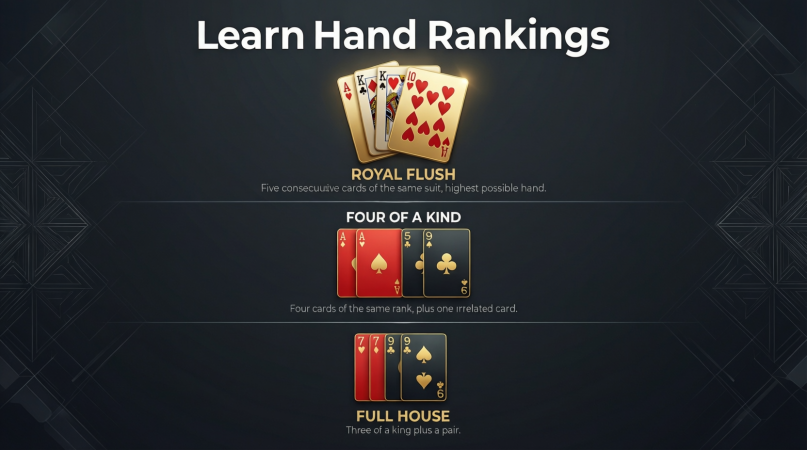
The first step is memorizing hand rankings. Know which hands are premium, strong, medium, or speculative. Examples include:
- Premium hands: AA, KK, QQ, AK
- Strong hands: JJ, TT, AQ, AJ suited
- Medium hands: KQ, AT, 99, 88
- Speculative hands: Suited connectors, small pairs, suited one-gappers
This helps you instantly identify which hands are playable.
Step 2: Consider Your Position
Position is one of the most important factors in preflop play. Table positions are usually categorized as:
- Early Position (EP): First 2–3 seats to act. Only play strong hands like AA, KK, QQ, and AK.
- Middle Position (MP): Slightly more flexibility. Can add hands like JJ, AQ, or suited connectors.
- Late Position (LP): Button and cutoff positions. You can play a wider range of hands, including weaker suited connectors or lower pairs.
Being in a late position gives you more information about how opponents are acting, allowing for better decisions.
Step 3: Adjust for Table Dynamics
Always consider the table’s playing style:
- Tight tables: Opponents fold often. You can steal more blinds with aggressive preflop raises.
- Loose tables: Opponents call frequently. Focus on playing stronger hands to maximize value.
Adjusting to table dynamics can significantly improve your preflop strategy.
Step 4: Decide to Fold, Call, or Raise
Once you know your hand strength and position, decide your preflop action:
- Fold: Weak hands, especially from early positions.
- Call: Medium-strength hands in favorable positions or when pot odds are good.
- Raise: Premium hands or when aiming to steal blinds from late position.
Raising is often more profitable than calling because it allows you to control the pot and gather information about opponents.
Step 5: Consider Stack Sizes
Your stack size affects hand selection:
- Deep stacks (100+ big blinds): Can play speculative hands like suited connectors or small pairs.
- Medium stacks (50–100 big blinds): Focus on premium and strong hands.
- Short stacks (<50 big blinds): Only play top hands aggressively, as implied odds for weaker hands are limited.
Adjusting hand selection to your stack size is essential for effective preflop strategy.
Step 6: Pay Attention to Opponents
Observe opponents’ tendencies:
- Tight players: Play fewer hands. You can steal more often.
- Loose players: Play many hands. Value bet strong hands.
- Aggressive players: Be cautious with marginal hands; they may raise or re-raise frequently.
Reading opponents early helps you decide which hands to play and how to act preflop.
Step 7: Use Hand Charts as a Reference
Many players use preflop hand charts to guide decision-making. While not mandatory, charts provide a visual reference of which hands to open, call, or fold from different positions. Over time, you can rely less on charts as your experience grows.
Benefits of Preflop Starting Hands
Understanding preflop hands provides several benefits:
- Higher win rate: Better starting hands lead to more profitable post-flop play.
- Reduced losses: Avoiding weak hands minimizes losing chips.
- Confidence in decisions: Clear preflop strategy removes guesswork.
- Better reads on opponents: Playing standard hands helps you interpret opponents’ actions.
- Strategic flexibility: Allows for aggressive or conservative play depending on the situation.
Proper preflop play is often the difference between a losing and winning player in poker.
Disadvantages / Risks
Even with strong preflop knowledge, there are risks:
- Over-reliance on charts: Blindly following charts without reading opponents can be limiting.
- Predictability: Always raising the same hands can make you predictable.
- Variance: Even premium hands can lose; luck still plays a role.
- Poor adjustment: Not adjusting to table dynamics can lead to losses.
- Emotional tilt: Misreading your hand strength or position can trigger poor decisions.
Being aware of these risks allows you to mitigate them and refine your preflop strategy.
Common Mistakes to Avoid
- Playing too many weak hands: Leads to unnecessary losses.
- Ignoring position: Early position requires stronger hands.
- Failing to adjust: Table dynamics change; strategy must adapt.
- Overvaluing suited connectors: Only play them with proper stack and position.
- Chasing losses: Playing weak hands to recover chips is risky.
- Not observing opponents: Missing tells and tendencies reduces effectiveness.
- Neglecting stack size: Size affects which hands are profitable.
Avoiding these mistakes is crucial for becoming a successful preflop player.
May be you like it:
Bonus Terms Explained – A Complete Beginner’s Guide
Safe Gambling Checklist: Tips for Responsible Play
Bankroll Management – The Ultimate Guide for Beginners and Intermediates
FAQs
1. What are the best preflop starting hands?
The best starting hands are pocket Aces (AA), Kings (KK), Queens (QQ), and Ace-King suited (AKs). These hands have the highest chance of winning against multiple opponents.
2. How does position affect preflop hand selection?
Position determines how many players act after you. Early positions require strong hands to reduce risk, while late positions allow for a wider range due to more information on opponents’ actions.
3. Can you play speculative hands preflop?
Yes, speculative hands like suited connectors or low pairs can be profitable with deep stacks and good position. They offer implied odds if they hit strong post-flop hands.
4. Should I always raise with premium hands?
Generally, yes. Raising with premium hands builds the pot and isolates weaker opponents, increasing your chances of winning a larger pot.
5. How do stack sizes influence preflop decisions?
Short stacks limit implied odds, so only strong hands are playable. Deep stacks allow more speculative play. Adjusting for stack size is essential to maximize profitability.
6. Are preflop charts necessary?
Charts are helpful for beginners to learn hand ranges and position play. However, advanced players often adjust based on table dynamics and opponent tendencies.
7. How do I avoid being predictable preflop?
Mix your hand selection and occasionally play non-standard hands in late position. Observing opponents’ reactions also helps prevent predictability.
8. Can preflop strategy improve overall poker skills?
Absolutely. Strong preflop decisions set the stage for better post-flop play, reduce losses, and increase your overall win rate.
Expert Tips & Bonus Points
- Play tight early, loosen later: Conserving chips early allows you to exploit weaker opponents from late positions.
- Raise sizing matters: Standard raise sizes are 2–3 big blinds in cash games. Adjust based on table dynamics.
- Avoid overcalling: Passive play with mediocre hands often leads to losing pots.
- Observe opponents’ preflop tendencies: Who raises, calls, or folds frequently? This info guides your strategy.
- Adjust to stack-to-pot ratio (SPR): The relative size of the pot compared to your stack affects your hand choices and post-flop strategy.
- Practice patience: Waiting for good hands is often more profitable than chasing speculative hands.
- Keep learning: Use software or hand review tools to analyze your preflop decisions for improvement.
Conclusion
Preflop starting hands form the foundation of every poker hand. Selecting the right hands, considering your position, stack size, and opponents’ tendencies, can significantly influence your success. Beginners often make the mistake of playing too many weak hands or ignoring position, leading to losses. By learning hand rankings, understanding position, and adjusting to table dynamics, you can make smarter preflop decisions and maximize your profit potential.
Mastering preflop strategy is not just about memorization; it’s about observation, adaptability, and disciplined decision-making. With practice, patience, and attention to detail, your preflop play will improve, and your overall poker game will become more profitable and enjoyable. Remember, strong preflop decisions set the stage for winning hands and consistent long-term success at the poker table.
By implementing the strategies, avoiding common mistakes, and following expert tips, you can confidently navigate the complexities of preflop starting hands and take your poker game to the next level.
May be you like it:
Winning Micro Stakes – A Beginner’s Guide to Profitable Small-Bet Poker
3-Bet & 4-Bet Explained – A Beginner-Friendly Guide to Advanced Poker Moves
Reading Opponents – Mastering the Art of Understanding Your Competition
