


Introduction
If you’re new to poker or just looking to sharpen your skills, understanding common poker terms is essential. Poker is a game of strategy, psychology, and luck, and knowing the right vocabulary can give you a huge advantage. From the basic terms like “call” and “fold” to more advanced phrases like “nuts” or “slow play,” every term has its place in helping you make smarter decisions at the table.
Many beginners feel overwhelmed when they first sit at a poker table because players often use jargon quickly and casually. This can lead to confusion or mistakes that cost money or chips. By learning these terms in advance, you can participate confidently and even impress other players with your knowledge.
In this guide, we will cover everything you need to know about common poker terms, their meanings, practical examples, and how to use them to improve your game. Whether you play online or in a live casino, mastering this terminology will make your poker experience smoother and more enjoyable.
By the end of this article, you will not only understand what each term means but also how to apply it in real-game scenarios. You’ll gain the confidence to read the table, understand opponents’ strategies, and make smarter bets. Let’s dive in and unlock the language of poker.
What is Common Poker Terms?
Common poker terms are the words and phrases used by poker players to describe actions, hands, strategies, and situations in the game. These terms are a combination of technical language, slang, and traditional poker vocabulary. They help players communicate efficiently and understand the game on a deeper level.
For instance, terms like “bluff” and “check-raise” describe specific moves, while phrases like “full house” or “straight” indicate the value of a hand. Knowing these terms is crucial for both beginners and intermediate players because poker is not just about the cards—it’s also about strategy and timing.
Without understanding these common terms, players may misinterpret the action at the table, leading to costly mistakes. Learning them allows you to follow the flow of the game, make strategic decisions, and interact confidently with other players.
Why is Common Poker Terms Important?
Knowing common poker terms is important for several reasons:
- Improved Game Understanding: Poker is complex, and terms help you understand every action and scenario.
- Better Communication: Using poker vocabulary correctly allows you to interact with other players without confusion.
- Strategic Advantage: Recognizing terms like “semi-bluff” or “slow play” helps you anticipate opponents’ moves.
- Confidence Boost: Understanding poker jargon prevents hesitation and allows you to make timely decisions.
- Enhanced Learning: The more you know, the faster you can progress from beginner to intermediate or advanced levels.
By mastering these terms, you reduce mistakes and increase your chances of making profitable decisions.
May be you like it:
Common Poker Terms – A Beginner’s Guide to Mastering the Game
Top Providers to Know – A Beginner’s Complete Guide
Mobile Casino Tips: Maximize Your Gaming Success
Detailed Step-by-Step Guide to Common Poker Terms
Here’s a breakdown of the most important common poker terms you should know, organized by category.
1. Basic Actions
- Call: Matching the current bet made by another player. Example: If the bet is $10, you put in $10 to stay in the hand.
- Fold: Giving up your hand and exiting the current round. Example: If your hand is weak, folding prevents further losses.
- Check: Passing the action to the next player without betting. Example: You can check if no bet has been made before you.
- Bet: Placing chips in the pot. Example: You bet $20 because you have a strong hand.
- Raise: Increasing the current bet. Example: The bet is $10, and you raise to $25.
2. Poker Hand Rankings
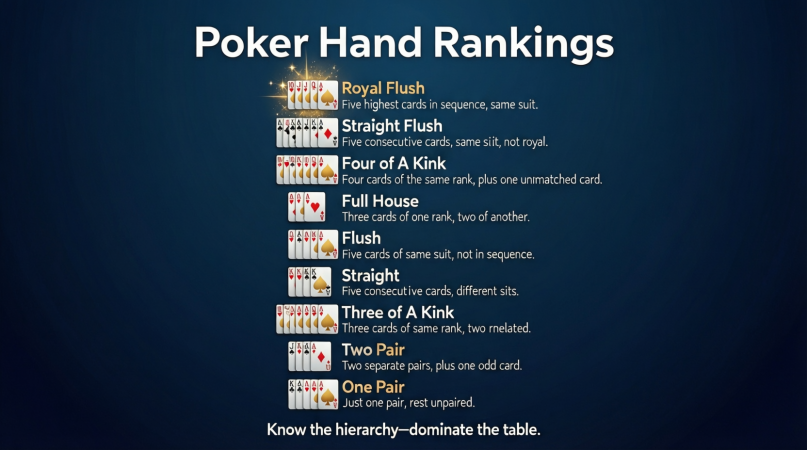
- High Card: The highest card in your hand when no other combination is formed.
- Pair: Two cards of the same rank, e.g., two 8s.
- Two Pair: Two different pairs in one hand, e.g., two 7s and two Kings.
- Three of a Kind (Set/Trips): Three cards of the same rank.
- Straight: Five consecutive cards of any suit, e.g., 5-6-7-8-9.
- Flush: Five cards of the same suit, e.g., all hearts.
- Full House: Three of a kind plus a pair, e.g., three Queens and two 5s.
- Four of a Kind (Quads): Four cards of the same rank.
- Straight Flush: Five consecutive cards of the same suit.
- Royal Flush: A, K, Q, J, 10 of the same suit—highest hand in poker.
3. Strategy Terms
- Bluff: Pretending you have a stronger hand than you do to make opponents fold.
- Semi-Bluff: Betting or raising with a hand that could improve, e.g., a flush draw.
- Slow Play: Playing a strong hand passively to lure opponents into betting.
- Check-Raise: Checking first and then raising when an opponent bets.
- Pot Odds: The ratio of the current pot size to the cost of a potential call.
- Position: Your seat relative to the dealer; being “on the button” is advantageous.
4. Other Useful Terms
- The Nuts: The best possible hand at a given moment.
- Kicker: The highest card that determines the winner when hands tie.
- Community Cards: Cards shared by all players in games like Texas Hold’em.
- Muck: Discarding your hand without revealing it.
- All-In: Betting all your chips in a single move.
Benefits of Common Poker Terms
Learning common poker terms offers several advantages:
- Improves understanding of game mechanics
- Enhances communication with other players
- Increases chances of winning through strategic moves
- Boosts confidence at the poker table
- Speeds up decision-making
- Helps in analyzing opponents’ behavior
Disadvantages / Risks
While learning poker terms is mostly beneficial, there are minor risks if not applied carefully:
- Overconfidence: Misusing terms can make you appear inexperienced.
- Confusion: Learning too many terms at once can overwhelm beginners.
- Misinterpretation: Some slang has different meanings in different regions or games.
- Dependence on Jargon: Relying on terms without understanding strategy won’t improve results.
Common Mistakes to Avoid
- Using Terms Incorrectly: Mislabeling a hand or action can confuse others.
- Ignoring Position: Terms like “on the button” are meaningless without positional strategy.
- Overbluffing: Bluffing without context is a costly mistake.
- Skipping Basic Terms: Not knowing basic terms like call or fold leads to errors.
- Neglecting Odds: Ignoring pot odds or probabilities can hurt your bankroll.
May be you like it:
Bonus Terms Explained – A Complete Beginner’s Guide
Safe Gambling Checklist: Tips for Responsible Play
Bankroll Management – The Ultimate Guide for Beginners and Intermediates
FAQs
1. What are the most important poker terms for beginners?
For beginners, focus on terms like call, fold, bet, raise, check, bluff, and hand rankings. These basics form the foundation of all strategic decisions.
2. How can I remember poker terms easily?
Practice consistently. Play low-stakes games, write down unfamiliar terms, and review them before each session. Using terms in context helps retention.
3. Do all poker games use the same terms?
Most terms are universal, but some games have unique terminology. For example, Omaha and Texas Hold’em share most terms but differ slightly in strategy-related phrases.
4. What does “the nuts” mean in poker?
“The nuts” refers to the best possible hand at any moment. If you have the nuts, no other player can beat you with their current cards.
5. How do position terms affect gameplay?
Your position determines when you act in a round. Being “on the button” means you act last, giving you more information and strategic advantage.
6. Can I win without knowing poker terms?
It’s possible, but highly unlikely at higher levels. Understanding terms is essential for reading the table, betting correctly, and anticipating opponents’ strategies.
7. What is the difference between a bluff and a semi-bluff?
A bluff is betting with a weak hand to make others fold, while a semi-bluff has potential to improve, like a flush or straight draw.
8. Are slang terms like “quads” and “trips” necessary to know?
Yes, they help you communicate faster and understand discussions with other players. Using slang correctly can also earn respect at the table.
Expert Tips & Bonus Points
- Always know your hand rankings before focusing on strategy.
- Practice using poker terms while playing to reinforce learning.
- Pay attention to opponents’ verbal and non-verbal cues; terminology often hints at their strategy.
- Use position to your advantage; acting last gives you more control over the pot.
- Avoid overcomplicating your play; start simple and gradually incorporate advanced terms.
- Keep a glossary of terms nearby when learning; even pros review occasionally.
Conclusion
Mastering common poker terms is a vital step for anyone serious about improving their game. From basic actions like call, fold, and check, to advanced strategies like semi-bluff and slow play, knowing the language of poker allows you to make smarter decisions and communicate effectively at the table.
Whether you play for fun, online, or in live casinos, understanding these terms gives you confidence and a competitive edge. Remember, poker is as much about strategy and psychology as it is about cards. By consistently learning and applying these terms, you’ll not only avoid costly mistakes but also enhance your overall poker experience.
Start practicing these terms today, review them regularly, and watch as your gameplay improves. Soon, what seemed like confusing jargon will become second nature, and you’ll be able to focus on winning hands instead of worrying about what other players are saying.
With knowledge, practice, and patience, you’ll be well on your way to becoming a skilled poker player who understands both the game and its language.
May be you like it:
Winning Micro Stakes – A Beginner’s Guide to Profitable Small-Bet Poker
3-Bet & 4-Bet Explained – A Beginner-Friendly Guide to Advanced Poker Moves
Reading Opponents – Mastering the Art of Understanding Your Competition
